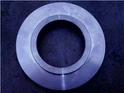
The forging machine is used to exert pressure on the metal blank to make it plastic deformation to obtain the processing method of forgings with certain mechanical properties, certain shape and size. Through continuous hammering on the pipe fittings, the original segregation, porosity, porosity, slag inclusion, etc. in the ingot are compacted and welded, and the structure becomes compact, which improves the plasticity and mechanical properties of the metal. Forged pipe fittings mainly include forged flanges, forged reducers, forged tees, etc. The main materials of forged pipe fittings are q235, q345,16mn, 20 #, 35 #, 45 #, 40Cr, 12Cr1MoV, 30CrMo, 15CrMo, 20G, etc.
Corresponding to forged flange forged pipe fittings is cast pipe fittings. The mechanical properties of the castings the mechanical properties of forgings made of the same material. The cast pipe fittings melt the metal into a liquid meeting certain requirements and pour it into the casting mold. After cooling, solidification and cleaning, the casting (parts or blanks) with predetermined shape, size and properties can be obtained.
The method used for forging and welding pipes minimizes the formation of upsetting in the welding area, including: forming the pipe ends to be welded together into an inward inclined configuration, so that when the pipe ends are heated during the forging and welding process, as a result of thermal expansion, the heated pipe ends become a cylinder shape that is basically longitudinally oriented. The method comprises: forming the pipe ends to be welded together into an inclined configuration, which is characterized in that the inclined configuration is such that when the pipe ends are heated during the forging and welding process, as a result of thermal expansion, the heated pipe ends become a basically vertically oriented cylinder shape.
The position of forged pipe flange pipe ends is monitored by a camera connected to a high temperature measurement and position monitoring system, which automatically adjusts the relative position of pipe ends and the heat added to the pipe ends during the heating process until the pipe ends reach a predetermined temperature, and then moves the pipe ends relative to each other.