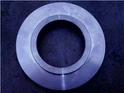
Advantages of die forging for forged flanges:
• the die forging production efficiency of forged flanges is high. During die forging, the deformation of metal is carried out in the die chamber, so the required shape can be obtained quickly;
• die forging of forged flanges can forge forgings with complex shapes, make the distribution of metal streamline more reasonable, and improve the service life of parts;
• the die forging of forged flanges has accurate dimensions, good surface quality and small machining allowance;
• die forging of forged flanges can save metal materials and reduce the workload of cutting and processing.
• under the condition of sufficient batch, the die forging of forged flanges can reduce the cost of parts.
Disadvantages and limitations of die forging of forged flanges:
• the weight of die forgings for forged flanges is limited by the capacity of general die forging equipment, mostly below 7okg;
• the forging die for forging flange has long manufacturing cycle and high cost;
• the investment cost of die forging equipment for forging flanges is greater than that of free forging.
Roll forging of forged flanges
Roll forging of forged flange refers to the forging process that uses a pair of opposite rotating fan-shaped dies to make the raw materials of forged flange produce plastic deformation, so as to obtain the required forgings or forgings.
The principle of roll forging deformation of forged flange is shown above. The roll forging deformation of forged flange is a complex three-dimensional deformation. Most of the deformed materials flow along the length direction to increase the blank length of the forged flange, and a small amount of materials flow laterally to increase the blank width. During the roll forging process of forged flange, the cross-sectional area of blank root decreases continuously. Roll forging of forged flanges is applicable to deformation processes such as long and high neck flanges, slab rolling and material distribution along the length direction.