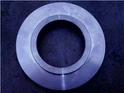
die forging of stainless steel flanges:
The closing film of stainless steel flange is usually composed of upper and lower molds. In order to make the upper and lower molds of the stainless steel flange match and prevent the stainless steel flange from dislocation, guide posts and guide pins are often used for positioning. The clamping of stainless steel flange is mostly used to produce non rotating forgings with complex shapes, such as connecting rod, fork forgings, etc.
Compared with free forging, die forging of stainless steel flange has the following advantages:
(1) Because the blank of stainless steel flange is formed in the die bore, the forging size is relatively accurate, the surface is relatively smooth, and the distribution of streamline structure is relatively reasonable, so the quality is higher;
(2) Die forging of stainless steel flange can produce forgings with complex shapes; Because the shape of the forging is controlled by the die bore, the blank is formed faster, and the productivity is 1 ~ 5 times higher than that of free forging;
(3) Stainless steel flange has less residual blocks, so the machining allowance is small, which can not only save the material of stainless steel flange, but also reduce the machining hours.
Disadvantages and limitations of die forging of stainless steel flanges:
(1) Forging hammer with large tonnage is required;
(2) Only small forgings and stainless steel flanges can be produced;
(3) The service life of the mold of stainless steel flange is low;
(4) When working, you usually need to move the tire mold manually, so the labor intensity is large;
(5) Die forging of stainless steel flanges is used to produce medium and small batches of forgings.