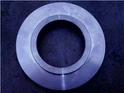
Attention shall be paid to weld grinding of anti-corrosion steel pipe and stainless steel flange
1) There shall be 10-20mm polyethylene layer flat section with no weld reinforcement as the pipe body from the weld grinding start of steel pipe and stainless steel flange to the polyethylene chamfer, so as to ensure the extrusion bonding quality at the polyethylene groove at the interface of steel pipe and stainless steel flange. 2) The weld reinforcement of steel pipe and stainless steel flange after grinding shall be flush with the pipe body as far as possible without obvious reinforcement, so as to prevent the epoxy powder from being polished off together when grinding the chamfer of polyethylene layer. 3) The chamfer of the transition section between the top of the steel pipe and stainless steel flange whose weld has not been polished and the grinding place shall also be the same as that of the polyethylene layer (≤ 30 °), so that the extrusion force of the extrusion roller can be evenly applied to the polyethylene layer to prevent the edge warping of the polyethylene layer due to poor adhesion of the anti-corrosion layer at the groove. The epoxy powder coating on the reserved section can delay the edge warping caused by corrosion at the interface between the steel pipe and the stainless steel flange only if it is completely protected. In China, the polyethylene groove at the pipe end is polished by steel wheel, which will damage the epoxy powder coating. The groove shall be machined instead. The bottom layer of the cutting edge shall be equipped with a limit device to control the cutting depth of the cutting tool, so as to avoid damaging the epoxy powder coating. Anti corrosion and thermal insulation coating: in order to reduce the heat dissipation of steel pipe and stainless steel flange to the soil on the medium and small caliber hot crude oil or fuel oil pipelines, a composite layer of thermal insulation and anti-corrosion is added to the outside of the pipeline. The commonly used thermal insulation material is rigid polyurethane foam, and the applicable temperature is - 185 ~ 95 ℃. This material is soft. In order to improve its strength, a layer of high-density polyethylene is applied outside the insulation layer to form a composite material structure to prevent groundwater from penetrating into the insulation layer.