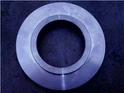
There are many ways of making flange connections
Flange connection is one of the most basic and common connections in various containers and process pipelines. Due to the requirements of the production process or considering the convenience of manufacturing, transportation, installation and maintenance. The container and process pipe connection often use removable structure namely flange connection, it has good connection strength and tightness, and a wide range of applicable sizes; therefore, flange connection is widely used J in vacuum salt making enterprises. Because the medium in the container and pipe is sodium sodium solution (i. e. brine. Strong corrosive. Although the carbon steel flange has a high strong safety and good plasticity and shear. But the corrosion resistance is poor, generally used after a month will appear a large area of corrosion phenomenon. Extensive perforation occurred after six months. Cause media leakage. If the use of stainless steel flange: first, the price is more expensive. Flange connects stainless steel valves with a flange at both ends, corresponding to the flange on the pipe, and is installed in the pipe by bolt fixing the flange. Flange connections are the most used form of connection in stainless steel valves. Flange has convex surface (RF), plane (FF), convex concave surface (MF), etc. According to the shape of the binding surface, it can be divided into the following types: 1) Smooth type: used for stainless steel valves with low pressure. Processing is more convenient 2) Conump: high working pressure, can use medium hard washer 3) Tenon and groove type: usable plastic deformation of the large gasket, widely used in corrosive media, the sealing effect is good. 4) trapezoadder groove type: with oval metal ring as gasket, used in working pressure of 64 kg / cm 2 valve, or high temperature valve. 5) Lens type: the gasket is a lens shape, made of metal. For high pressure valve with working pressure of 100 kg / cm 2, or high temperature valve. 6) O-rings: This is a new form of flange connection, which is developed with the emergence of various rubber O-rings.