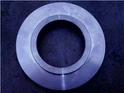
Common carbon steel and casting flanges are different
Carbon steel flanges are flanges made of carbon steel material. According to the content of various trace elements, it can be divided into A105 material, Q235 material, 16Mn material, 20 material, etc. Because the carbon steel flange itself does not have the anticorrosion function, the main anticorrosion treatment includes oil coating, spray painting and galvanizing. According to the production process, it can be divided into forging flange, casting flange, plate rolling and plate cutting. Among them, the forging flange has good quality, followed by rolling and casting. Forging flange is a flange product with good mechanical performance. It is usually made from a billet, and is heated after cutting. After complete heating, put into the mold and hammer to eliminate defects such as segregation, loose and air inside the billet. Therefore, the forged flange has good pressure resistance and temperature resistance, generally suitable for high temperature and high pressure environment. Ordinary carbon steel flange blank shape and size is accurate, small processing capacity, low cost, but the casting flange will have pores, cracks and impurities, the internal structure of the cast streamline is poor. It has the advantage that it can have more complex shapes and has a low cost to produce. Because the carbon content of ordinary carbon steel flange is lower than the casting flange, it is not easy to rust, dense structure, can withstand large shear force and tension, its mechanical properties are better than the forging flange. Ordinary carbon steel flange and casting flange are not distinguishable by appearance only.1. Flange casting on the market is cheaper than the price, followed by forging. Prices are higher compared to pure forging.2. To do destructive tests and separate the flanges. Castings have sand eyes, but pure forgings do not. Sometimes the forged flanges can have cracks.3. From the perspective of the flange tolerance and the surface finish, the cast flanges usually have a negative tolerance of 1-5 mm, the irregular edge chamfer, the burr in the hole is not smooth, and the forged flange has a small tolerance.4. Is the weight, the same size of the flange, the casting will be lighter than the forging weight.