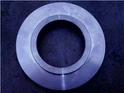
What is a Socket Weld Flange ?
The socket flange is abbreviated as (SW flange), the basic shape of the socket flange is the same as that of the flat welding flange with neck, that is, there is a socket hole in the inner hole of the flange, and the pipe is inserted into the socket hole and welded. Weld a circle of welds on the back of the flange. Due to the gap between the socket flange and the caulk, corrosion is easy to occur. If a seam is welded inside, this corrosion can be avoided. The fatigue strength of the socket flange welded on the inner and outer sides is 5% higher than that of the flat welding flange and the static strength is the same. When using this kind of socket flange, its inner diameter needs to be consistent with the inner diameter of the pipe. Socket flanges are only suitable for pipes with a nominal diameter of 50 or less.
Application range:
Boiler and pressure vessel, petroleum, chemical, shipbuilding, pharmaceutical, metallurgy, machinery, stamping elbow, food and other industries. Commonly used in pipelines with PN≤10.0MPa and DN≤50.
Advantages and disadvantages of socket welding and butt welding:
Socket welding is generally used for small pipe diameters less than or equal to DN40, which is more economical. Butt welding is generally used for DN40 and above. Socket welding means that the socket is first performed, and then the welding is performed. (For example, there is a flange called a socket flange, or a projection welding flange. This is how it is connected to other components (valves, etc.). Butt welding It is to directly weld the two components. The welding connection form between the flange and the pipeline, the socket welding generally inserts the pipeline into the flange for welding, and the butt welding is to use the butt welding flange to butt weld the pipeline and the butt surface. The socket welding joint cannot be radiographically inspected, but the butt welding is possible, so it is recommended to use the butt welding flange for the high requirements of the welding joint inspection.) Generally, the requirements for butt welding are higher than those for socket welding, and the quality after welding is also good, but the detection methods are relatively strict. Butt welding should do radiographic inspection, and socket welding should do magnetic particle or penetrant testing (like carbon steel for magnetic powder, stainless steel for penetration). If the fluid in the pipeline does not have high requirements for welding, it is recommended to use socket welding, which is convenient for inspection. The connection form of socket welding is mainly used for welding small-diameter valves and pipes, pipe fittings and pipes. Small-diameter pipes generally have thinner walls, are prone to misalignment and ablation, and are more difficult to weld, so they are more suitable for socket welding. In addition, the socket of socket welding has a reinforcing effect, so it is often used under high pressure. However, socket welding also has disadvantages. One is that the stress state after welding is not good, and the welding is prone to incomplete penetration. There are gaps in the pipe system. Therefore, it is not suitable for the pipeline system used for crevice corrosion-sensitive media and the pipeline system with high cleanliness requirements. Use socket welding. In addition, for ultra-high pressure pipelines, even small-diameter pipelines have a large wall thickness, and socket welding can be avoided as far as possible if they can be connected by butt welding.