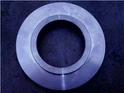
The passivation treatment of flange refers to that the corrosion rate of steel plate and other metals making flanges will be significantly reduced after being treated with oxidizing medium, which is the passivation treatment of flanges. Because of this feature, many flange buyers will require flanges to be passivated. The passivation principle of flange can be mainly explained by film theory, that is, it is considered that passivation is due to the interaction between the raw material of flange and oxidizing medium, which generates a very thin, dense, well covered passivation film that can be firmly attached to the metal surface. This film exists as an independent phase, usually a compound of oxygen and metals. It plays the role of completely separating the metal from the corrosive medium, preventing the direct contact between the metal and the corrosive medium, so that the metal basically stops dissolving and forms a passive state to achieve the effect of preventing corrosion. Passivation process of large flange can be divided into wet process and dry process. It can be divided into many types. The passivation effect of large flanges depends on both the passivation process and the large flange material itself. The specific influencing factors include the elements contained in large flanges, the metallographic structure of stainless steel, the processing state of stainless steel, etc. Among the constituent elements, chromium and nickel are elements with strong passivation, followed by iron. Therefore, the higher the content of chromium and nickel, the stronger the passivation of stainless steel. Austenitic and ferritic large flanges have relatively uniform structure and good passivation. Martensitic stainless steel is strengthened by heat treatment, and its metallographic structure is multiphase structure, so the passivation is not strong.
Jul 01, 2022
Passivation treatment of flange
Send Inquiry