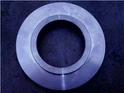
Many flat flanges also need heat treatment. The heat treatment of Plate Flanges is also divided into induction quenching and general quenching. However, the Plate Flanges of some factories are made of cast iron, while Shanxi Haokun flanges Group Co., Ltd. is made of carbon steel, stainless steel and alloy steel. Unlike steel, Plate Flanges produced by different types of cast iron may have similar chemical composition, but the reaction to induction quenching is quite different. In the steel producing Plate Flanges, the carbon content is determined by chemistry and cannot exceed this fixed value during austenitizing. In contrast, when cast iron is used to produce Plate Flanges, there is a carbon "reserve" in the primary (eutectic) graphite particles. The presence of these graphite particles and the ability of carbon to diffuse into the Plate Flanges at the austenitic phase temperature may lead to process changes, because it may lead to local deviations in the amount of carbon dissolved in the austenitic matrix. This may affect the chemical properties of the produced Plate Flanges obtained during heat treatment. Therefore, among other factors, the success and repeatability of induction quenching of Plate Flanges produced by cast iron are largely affected by the potential changes in the carbon content of Plate Flanges raw materials in the previous microstructure. If for some reason, the Plate Flanges has no expected effect on the induction quenching reaction, the first step to determine the root cause of this behavior is to ensure that the raw materials used in the production of Plate Flanges need not only the corresponding chemical composition, but also other factors.
Apr 28, 2022
Induction hardening of carbon steel Plate Flanges
Send Inquiry