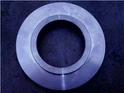
Dislocation of forged flange
The forging displacement of forged flange is the displacement of the upper half of the forging along the parting surface relative to the lower half. The causes may be: ① the gap between the slider (hammer) and the guide rail is too large; ② The design of the forging die for forging flange is unreasonable, and there is a lack of lock or guide post to eliminate the displacement force; ③ The die of forged flange is poorly installed.
Axis bending of forged flange
The forging axis of the forged flange is bent and has errors with the geometric position of the plane. The possible causes are: ① not paying attention to the forging flange when it is out of the mold; ② Uneven stress during trimming of forged flange; ③ The cooling rate of each part of the forged flange is different during cooling; ④ Improper cleaning and heat treatment of forged flanges.
Defects often caused by improper post forging cooling process of forged flange
Defects caused by improper cooling after forging of forged flanges usually include the following.
Cooling crack of forged flange
During the cooling process after forging of forged flange, the internal of forged flange will produce large thermal stress due to too fast cooling speed, and may also cause large structural stress due to structural transformation. If these stresses exceed the strength limit of the forged flange, the forged flange will produce smooth and slender cooling cracks.
Mesh carbide of forged flange
When forging steel with high carbon content of forged flange, if the stop forging temperature is high and the cooling speed is too slow, carbides will precipitate in a network along the grain boundary. For example, when bearing steel is slowly cooled at 870 ~ 770 ℃, carbides precipitate along the grain boundary.