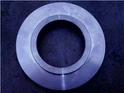
Defects caused by improper material preparation of forged flange and its influence on forgings
There are several defects caused by improper material preparation of forged flanges.
Improper material preparation of forged flange will produce skew
Skew refers to the improper material preparation of the forged flange. When loading and unloading on the sawing machine or punch, the bar material is not compacted, resulting in the inclination of the material end face of the forged flange relative to the longitudinal axis exceeding the specified allowable value. Severe skewing of forged flanges may cause folding during the forging process.
The blank end of forged flange is bent and burred
When the material of the forged flange is put on and off the cutting machine or punch, the blank of the forged flange has been bent before being cut because the gap between the cutting edges of the scissors or the cutting die is too large or the cutting edge is not sharp. As a result, part of the metal of the forged flange is squeezed into the gap of the blade or die, forming the drooping burr of the end forged flange.
Burr billets are easy to cause local overheating and overburning when heated, and folding and cracking of forged flanges are easy to occur during forging.
End crack of forged flange
When cold cutting large section alloy steel and high carbon steel bars, cracks are often found at the end of the forged flange 3 ~ 4h after cutting. It is mainly because the unit pressure of the blade is too large, which flattens the blank of the circular section into an ellipse. At this time, there is a great internal stress in the material of the forged flange. The flattened end face strives to restore the shape of the original forged flange.